Send
The supplier enters invoice data into their business software and initiates the invoicing process via their OpenPeppol Accredited Service Provider (ASP).


Who is in scope, the deadlines that matter, how the 5-corner model works — and a checklist to be ready before your phase begins.
Today, many UAE businesses send invoices as paper or PDF. Under the e-invoicing system, an in-scope invoice becomes structured data. It is checked by an Accredited Service Provider (ASP), delivered to the buyer’s ASP over the Peppol network, and its tax data is reported to the Federal Tax Authority (FTA) — continuously, not at the end of a tax period.
The framework is set by Ministerial Decisions No. 243 and No. 244 of 2025, with amendments to the VAT Executive Regulation and published implementation guidelines.
| Who | Appoint an ASP by | Go live |
|---|---|---|
| Pilot and voluntary adopters | — | From 1 July 2026 |
| Businesses with annual revenue of AED 50 million or more | 30 October 2026 (extended from 31 July 2026) | 1 January 2027 |
| Businesses with annual revenue below AED 50 million | 31 March 2027 | 1 July 2027 |
| Government entities | 31 March 2027 | 1 October 2027 |
Dates as published by the UAE Ministry of Finance, including the extension announced in May 2026. Always confirm against the latest official Ministry of Finance and FTA guidance before acting.
The supplier sends the invoice to its ASP, which validates it and passes it to the buyer’s ASP over Peppol. The buyer receives it, and tax data is reported to the FTA’s central data platform.
Decentralized Continuous Transaction Control and Exchange (DCTCE) · the 5-corner model
The supplier enters invoice data into their business software and initiates the invoicing process via their OpenPeppol Accredited Service Provider (ASP).
The business software of the customer is populated with the invoice data received from their ASP.
The sending ASP validates the invoice data to check defined standards are met and transmits the invoice data to the buyer ASP. Invoices can be issued direct B2B.
The sending ASP checks the details of the customer via the OpenPeppol directory facility prior to data being transmitted.
The invoice data is transmitted securely by the sending ASP to the receiving ASP over the OpenPeppol network.
The receiving ASP validates the invoice data and sends it to the business software of the customer in the format of their choice.
The receiving access point validates the data and transmits it to the Central Data Platform.
The data received from Corner 2 and Corner 3 will be processed.
Accredited Service Provider — a provider approved to validate and exchange e-invoices and report tax data on a business’s behalf.
The international network and standards used to exchange structured e-invoices between businesses.
Supplier (1) → supplier’s ASP (2) → buyer’s ASP (3) → buyer (4), with tax data reported to the FTA’s data platform (5).
Decentralised Continuous Transaction Control and Exchange — the UAE’s approach, where invoices flow between ASPs and tax data is reported continuously.
The UAE’s Peppol specification: the fields and rules a UAE e-invoice must follow.
Tax Registration Number — used to identify the supplier and buyer and to route invoices.
Federal Tax Authority — receives the tax data reported from each e-invoice.
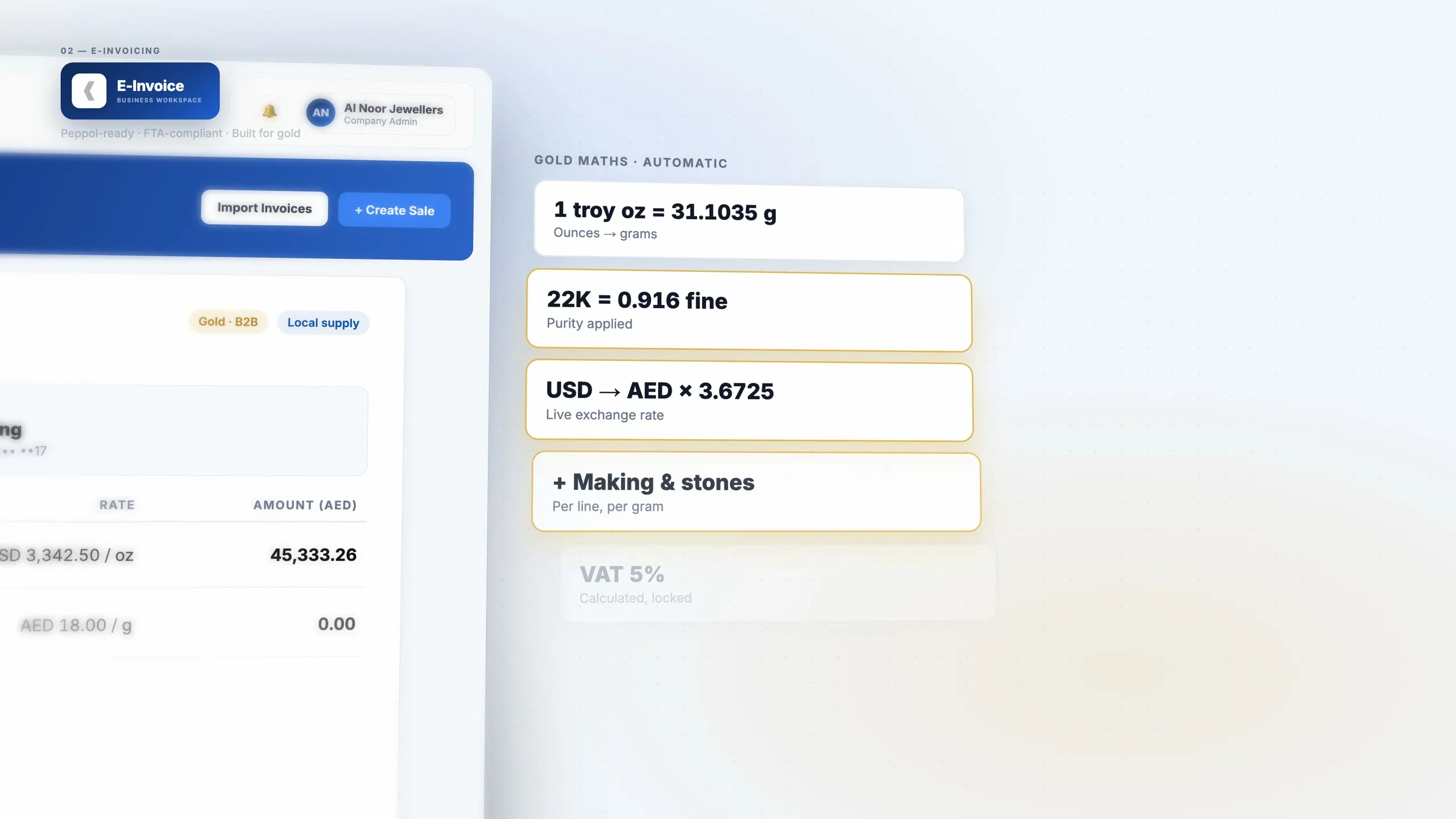
A single necklace can carry metal weight in grams, a USD per-ounce rate, purity, a discount or premium, making charges, stones and VAT — and the sale may be local, free zone, export or re-export. Every one of those values has to be right before it becomes structured data.
Work out your revenue band and the dates that apply to you.
Appoint an Accredited Service Provider before your deadline.
TRNs, addresses, items, units and tax codes for every client and supplier.
Local, free zone, export and re-export sales, plus credit and debit notes.
Send and receive test invoices and confirm the status comes back.
Make sure sales and finance know how to issue, check and receive e-invoices.
This guide is general information, not legal or tax advice.
It is phased. Businesses with annual revenue of AED 50 million or more go live on 1 January 2027, businesses below AED 50 million on 1 July 2027, and government entities on 1 October 2027. A pilot and voluntary adoption began on 1 July 2026.
For businesses with revenue of AED 50 million or more, the deadline was extended from 31 July 2026 to 30 October 2026. Businesses below AED 50 million and government entities must appoint an ASP by 31 March 2027.
Under the mandate, in-scope invoices must be issued as structured e-invoices exchanged through ASPs. A PDF can still be shared as a readable copy, but it is not the e-invoice itself.
Ministerial Decisions No. 243 and No. 244 of 2025 set out the e-invoicing system and its implementation timeline, supported by amendments to the VAT Executive Regulation and published guidelines.
Gold invoices carry metal weight, purity, rates, making charges and stones, and often mix local, free zone and export sales. Those details must be calculated correctly and mapped into structured fields. E-Invoice was built to do that automatically.
Yes, administrative penalties apply for failing to implement the e-invoicing system or appoint an ASP on time. Check the latest Ministry of Finance and FTA publications for the current amounts.

See KYC Hub, E-Invoice, the gold-ready ERP and e-commerce working together — on your own data, in under 30 minutes.